News center
Share
【概要描述】Applicable Standards: GB/T 1972, DIN EN 16983 (formerly DIN 2093)Applications: Construction Machinery, Power Equipment, Metallurgical Equipment, Rail Transit, Elevators & Escalators, Braking Systems,
【概要描述】Applicable Standards: GB/T 1972, DIN EN 16983 (formerly DIN 2093)Applications: Construction Machinery, Power Equipment, Metallurgical Equipment, Rail Transit, Elevators & Escalators, Braking Systems,
Applicable Standards: GB/T 1972, DIN EN 16983 (formerly DIN 2093)
Applications: Construction Machinery, Power Equipment, Metallurgical Equipment, Rail Transit, Elevators & Escalators, Braking Systems, etc.
Configuration Diagrams: Single Disc Spring, Parallel Stacking, Series Stacking, and Series-Parallel Combination
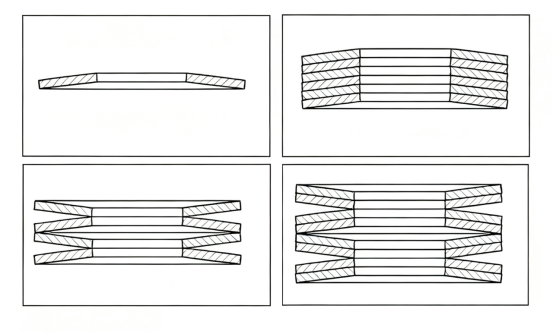
With high load capacity, controllable deflection, compact construction, and excellent vibration damping and preload characteristics, disc springs are widely used in industrial elastic systems. Different stacking configurations can be flexibly selected to meet the load and compensation-stroke requirements of different equipment. Based on years of experience in precision spring manufacturing, Raleigh Spring provides a professional analysis of the four major configuration types.
1. Single Disc Spring
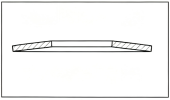
The total load capacity is equal to the rated load of a single disc spring, while the total deflection equals the maximum deflection of the single disc spring. This configuration is suitable for simple preloading applications with low loads, short compensation strokes, and limited installation space.
2. Parallel Disc Spring Configuration (Nested in the Same Direction)
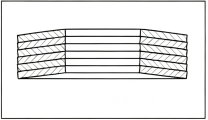
Total load capacity = load of a single disc spring × number of parallel springs. The total deflection remains the same as that of a single disc spring. The main purpose is to increase load capacity for high-pressure, short-stroke industrial applications.
3. Series Disc Spring Configuration (Alternating Opposite Directions)
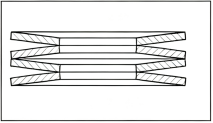
The total load capacity is equal to the rated load of a single disc spring, while the total deflection = deflection of a single disc spring × number of series units. The main purpose is to extend the elastic compensation stroke for applications requiring a large compensation range and continuous elastic preload.
4. Series-Parallel Disc Spring Combination
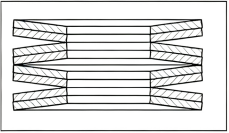
Combining the advantages of both parallel and series configurations, this arrangement can achieve both high load capacity and long stroke. It is one of the most widely used and versatile composite elastic solutions for complex industrial equipment.
Series assembly consists of disc springs stacked alternately in opposite directions to form an integrated elastic spring column. Its key advantage is to extend the elastic deflection stroke while maintaining stable load capacity.
Example: A single disc spring produces 1 mm deflection under a load of 5,000 N. After 10 disc springs are assembled in series, the same 5,000 N load can produce a total deflection of 10 mm, making it ideal for thermal expansion/contraction and gap compensation in equipment.
1. In long series-stacked assemblies, the disc springs at both ends experience greater deflection than those in the middle, which can lead to uneven load distribution and overload fatigue at the end springs. Long-term operation may therefore increase the risk of failure.
2. General industry design guideline: the total stacking length of disc springs in series should not exceed three times the outside diameter of the disc spring to ensure uniform load distribution and stable operation.
3. Disc springs of the same specification can be assembled uniformly, or disc springs with gradually varying thicknesses can be combined to achieve a stepped elastic characteristic. For mixed-thicknessassemblies, a stop/limiting device should be added to prevent thinner disc springs from being over-flattened and damaged.
Raleigh Spring Technical Optimization: For long series-stacking applications, Raleigh Spring uses carefully selected high-quality spring steel, high-precision end-face grinding, and strict heat-treatment processes to improve uneven load distribution in stacked disc springs, significantly reduce the risk of fatigue fracture during long-term reciprocating operation, and ensure stable equipment performance.
Parallel assembly consists of multiple disc springs nested in the same direction. The springs are loaded simultaneously and share the load. Its key advantages are a significant increase in overall load capacity, a compact structure without additional installation space, and unchanged deflection of each individual spring.
Example: A single disc spring produces 1 mm deflection under a load of 5,000 N. With three disc springs assembled in parallel, a load of 15,000 N is required to achieve the same deflection, significantly increasing load capacity. This configuration is suitable for heavy-duty equipment preloading and high-pressure vibration damping applications.
1. Same-direction nested disc springs experience friction at the contact interfaces. Under the same deflection, the overall load may increase by approximately 3%. Sufficient load margin should therefore be reserved during equipment design and selection to avoid insufficient load capacity.
2. Recommended engineering practice: no more than 3 disc springs per parallel group; no more than 5 under extreme conditions. This helps reduce frictional heating, maintain smooth loading and unloading curves, and prevent elastic performance degradation.
3. Parallel configurations provide excellent hysteretic damping characteristics, combining cushioning, vibration damping, and energy absorption. They are suitable for vibration and noise reduction as well as pressure cushioning in various types of equipment.
4. The service life of disc springs is closely related to contact-surface flatness and surface-treatment processes. Lubrication and corrosion-protection processes directly affect the service life of the equipment.
Raleigh Spring Process Advantages: All Raleigh Spring disc springs are manufactured using precision stamping processes, with flat, burr-free contact surfaces. We offer various surface treatments, including black oxide, phosphating, and electrophoretic coating, to effectively reduce inter-spring friction and improve corrosion resistance. These solutions are suitable for complex industrial environments involving humidity, high temperature, and high pressure, helping extend product service life.
A series-parallel combination uses multiple disc springs assembled in parallel as one basic unit, followed by multiple such units assembled in series. This composite structure combines the key advantages of both configurations and meets the dual requirements of high load capacity and long stroke, making it a preferred elastic solution for high-end precision equipment and large industrial machinery.
Example: A single disc spring has a load capacity of 5,000 N and a deflection of 1 mm. With 3 springs in parallel as one unit and 10 units assembled in series, the overall assembly can provide a load capacity of 15,000 N and a 10 mm elastic compensation stroke. Approximately 6% additional load should be reserved in the design calculation to account for friction and ensure operating accuracy.
This configuration requires precise matching of three key parameters: load, stroke, and installation space. Due to its high design complexity, professional technical verification is required.
Raleigh Spring Custom Service: Supported by a mature technical R&D system, Raleigh Spring can verify disc spring stacking solutions on a one-to-one basis according to the actual equipment load, compensation stroke, installation dimensions, and operating environment. We provide accurate load-deflection curves and assembly solutions, together with one-stop technical support covering selection, customization, production, and after-sales service.
Raleigh Spring specializes in the R&D, manufacturing, and customization of high-quality disc springs. We strictly follow GB/T 1972 and DIN 2093 international industry standards. Our products use high-quality spring steels such as 60Si2MnA and 51CrV4 and are manufactured through precision stamping, high-temperature heat treatment, high-precision grinding, corrosion protection, and other advanced processes.
Our products are suitable for precision machinery, industrial equipment, power equipment, rail transit, metallurgy and chemical industries, elevators, automotive applications, wind power generation,hydrogen energy equipment, valve and fluid systems, machine tool spindles, ladle slide-gate mechanisms, and other industrial applications. We support in-stock supply of standard parts, non-standard size customization, and application-specific solution design, and can provide free sample testing, technical drawings, and load parameter reports.
With many years of experience in the spring industry, Raleigh Spring has always taken high precision, high stability, and long service life as its core product standards, providing safe, reliable, and efficient elastic preloading and vibration damping solutions for industrial equipment.